






One Hard Nut to Crack: The Declaration of Independence’s Stubborn Defense of Human Life at 250 Years
ON JANUARY 22, 2023, Kamala Harris gave a speech to commemorate what would have been the 50th anniversary of Roe v. Wade. Addressed to a pro-abortion crowd, the speech was meant as a political rebuke to Republicans pushing for limits on abortion after 15 weeks of pregnancy. It argued for enshrining limitless abortion, available (and taxpayer-funded) at any time and for any reason, in federal law.
Early in the speech, Vice President Harris tried to draw on the strength of the American founding to support her point:
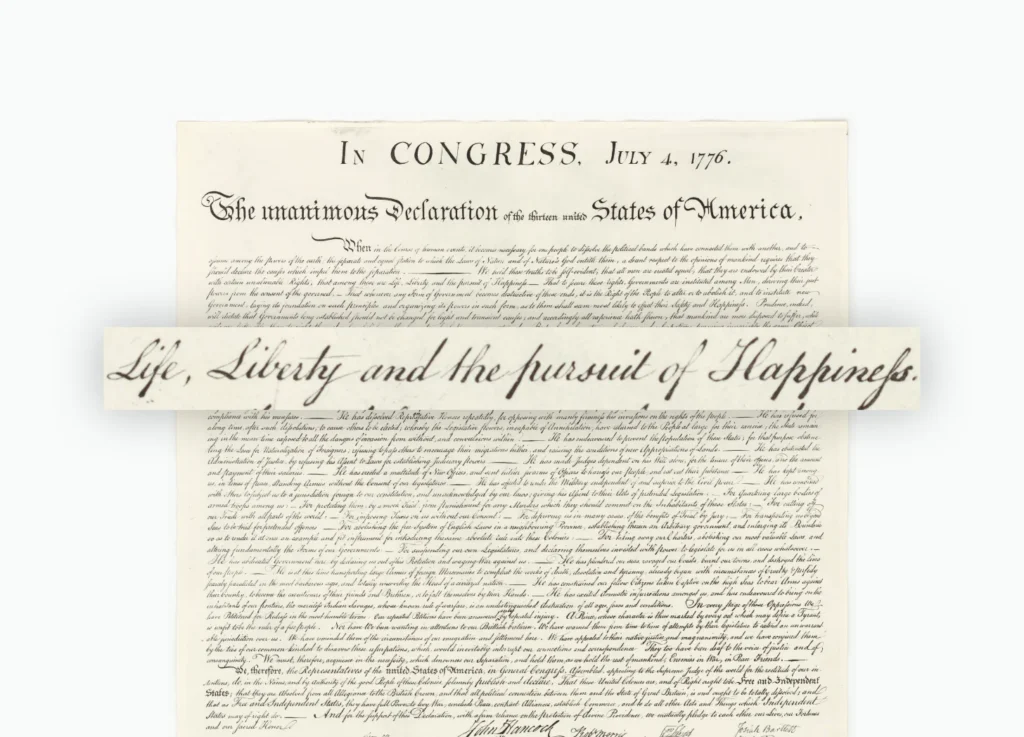
“We are here together because we collectively believe and know America is a promise. America is a promise. It is a promise of freedom and liberty – not for some, but for all. A promise we made in the Declaration of Independence that we are each endowed with the right to liberty and the pursuit of happiness.”
It was a huge gaffe—the only newsworthy part of an otherwise unremarkable speech. The passage she had clumsily edited is one of the most famous in American history, one schoolchildren can recite by heart.
By blatantly cutting out the “right to life” (and, while she was at it, the Creator), Harris only drew attention to her argument’s biggest problem. As even she could recognize, the principles of the Declaration are fundamentally incompatible with the practice of abortion. The Declaration—the legal and moral foundation of the United States government, justifying its existence even before the Constitution—states with absolute clarity that governments are duty-bound to protect the right to life God has given all human beings.
House Speaker Mike Johnson, a constitutional attorney, unpacks America’s Declaration
The Declaration Extends to All
The Founders’ argument is clear: It is a “self-evident” truth “that all men are created equal” and “endowed by their Creator with certain unalienable Rights,” including the right to life. Human beings, they argue, have inherent, God-given rights, by their very nature and from their creation. As Thomas Jefferson said elsewhere, the God who gave us life gave us liberty at the same time.
We have these rights because of what we are, not because we were given them by a ruler, or by a statute, or even by the Constitution. They are granted to us by God, not by the government. The Declaration states that if you are a human being, created by God, then you possess these rights.
Kamala Harris was not the first person to recognize the problem this poses for the pro-abortion side. Countless pro-lifers – including all pro-life presidents since Reagan – have pointed out that the principles of the Declaration clearly extend to all human beings, born and unborn, and oblige the government to protect their rights. Even Associate Justice Harry Blackmun, writing the majority opinion in Roe, conceded that if the unborn are persons, the case for legal abortion “collapses.”
As Ronald Reagan was able to say nearly 40 years ago:
Medical evidence leaves no room for doubt that the distinct being developing in a mother’s womb is both alive and human. This merely confirms what common sense has always told us. Abortion kills unborn babies and denies them forever their rights to “Life, Liberty and the pursuit of Happiness.” Our Declaration of Independence holds that governments are instituted among men to secure these rights, and our Constitution—founded on these principles—should not be read to sanction the taking of innocent human life.
In the years since, the evidence has only become clearer: With fingerprints, beating hearts and faces like ours, who respond to the human voice and who experience pain perhaps even more intensely than we do, the unborn are, undeniably, living human beings (marvelously intricate and complex ones at that). If we agree with the Declaration, their humanity makes them full possessors of the inherent right to life. It entitles them to legal protection—and obligates governments to secure it, or risk becoming destructive and losing legitimacy.
The Declaration Matters
Those who want to argue for a right to abortion have only two ways out. They can either argue that the Declaration is wrong, or they can argue that the Declaration doesn’t matter.
“If that Declaration is not the truth,” said President Lincoln in 1858, “let us get the Statute book, in which we find it and tear it out!” To this day, it is placed at the very beginning of the United States Code as the first organic law of the United States. Its statements of moral fact have real weight.
The Declaration and the Constitution are, John Quincy Adams said, complementary, forming together “one entire system of national government” as “parts of one consistent whole[.]” Echoing Proverbs 25:11, Lincoln called the Declaration “the word ‘fitly spoken’ which was proved an ‘apple of gold’ to us,” while the Union and the Constitution “are the picture of silver subsequently framed around it. . . . The picture was made for the apple—not the apple for the picture. So let us act, that neither picture, or apple shall ever be blurred, or bruised or broken.”
A Hard Nut to Crack
As Lincoln pointed out, the Founders didn’t need to include such sweeping statements about the rights of men. The assertion of our natural equality from the moment of creation, he noted, “was of no practical use in effecting our separation from Great Britain[.]”
Instead, Lincoln said, they made such statements “for future use.” “Its authors,” he said, “meant it to be, thank God, it is now proving itself, a stumbling block to those who in after times might seek to turn a free people back into the hateful paths of despotism.” When such people did turn up, the Declaration would ensure, at least, that “they should find left for them at least one hard nut to crack.”
Today, the Declaration proves a stumbling block to those who deny the unborn their right to life. It leaves no place for national abortion mandates like the deceptively titled Women’s Health Protection Act that Harris and every other Democrat sponsored in the Senate and vowed to pass. Its words are so plain, abortion supporters are forced into contortions to avoid speaking them aloud.
On the 250th anniversary of the Declaration we re-affirm, with Lincoln, that the founders meant what they said: all men are created equal. All human beings are endowed by their Creator with the right to life. The fundamental premise of our nation is that no government can take that right away and all have a duty to protect it.
Declaration of Independence for the Unborn
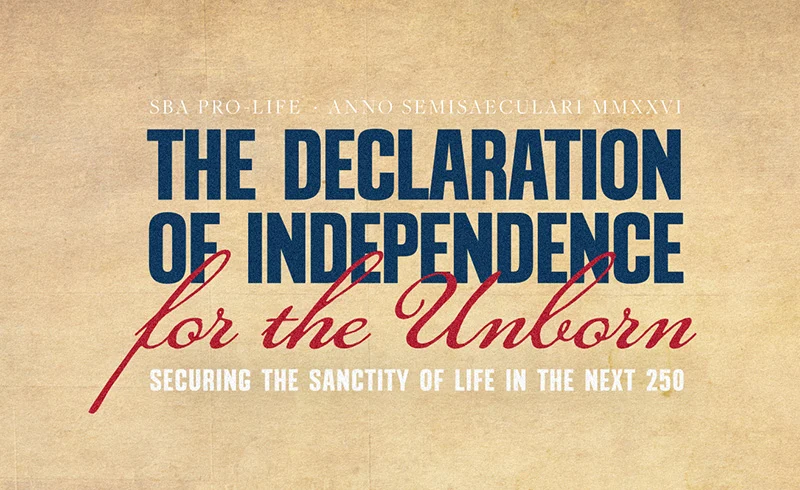
Sign your name to declare that in America’s next 250 years we must preserve every unborn child’s right to live, dream, and inherit the American promise.
Add Your Name to Say You Stand for LIFE
When the U.S. Supreme Court overturned Roe v. Wade, our movement was given a historic opportunity. But the battle for life became much more difficult.
Add your name with thousands of others who are committed to protecting mothers the right to life for innocent unborn children.
Add My Name