

- About
-
- Impact
-
- Resources
-
- Take Action
-
- News
-
-
-

The Pro-Life American Episode 2: Discussing the Hyde Amendment on 50th Anniversary
The Hyde Amendment turns 50 this month. On paper it’s a small line in the…
-
-
-



-
-
-
-
-
-
-
-
-
-
- Leading Nat’l Pro-Life Group Endorses Jenny Costa Honeycutt for Congress in SC-01For Immediate Release: Oct. 15, 2026 Contact: [email protected] | View Newsroom Charleston, …
 $1.35 Million Campaign in IA Goes After Democrats Turek & Sand Over Extreme Pro-Abortion AgendaFor Immediate Release: October 8, 2026 Contact: [email protected] | View Newsroom Des Moines, IA …
 Statement on the FDA’s Mifepristone Study UpdateFor Immediate Release: Oct 7, 2026 Contact: [email protected] | View Newsroom Washington, D.C. – In …
 Nation’s Largest Pro-Life Voter Contact Program Exceeds 3 Million Visits to Battleground Voters’ HomesFOR IMMEDIATE RELEASE: October 6, 2026 Contact: [email protected] | View Newsroom Democrats’ Embrace …
 $8M Campaign Slams Democrats in Key Races on Extreme Abortion AgendaFOR IMMEDIATE RELEASE: October 6, 2026 Contact: [email protected] | View Newsroom Washington, D.C. – …
- Leading Nat’l Pro-Life Group Endorses Jenny Costa Honeycutt for Congress in SC-01
-
-
-




-
Donate
Your support powers life-saving laws, leaders, and advocacy that protects unborn lives. -
-
-
Stay up-to-date with our latest victories, advocacy campaigns, and pro-life stories.News For The Press
The Pro-Life American Episode 2: Discussing the Hyde Amendment on 50th Anniversary
The Hyde Amendment turns 50 this month. On paper it’s a small line in the…
Late-Term Abortion
Americans Overwhelmingly Reject Late-Term Abortion
Both before and after Dobbs, multiple polls show at least 7 in 10 Americans support significant limits on abortion, with most favoring limits after three months of pregnancy at most. Abortion on demand for any reason, at any point throughout pregnancy is an extreme, minority position.
Support Democrat position of no-limits, all-trimester abortion on demand
Source: Harvard/Harris, Jun. 2022
Are Late-Term Abortions Only Done in Extreme Circumstances?
“Most late-term abortions are done for the same social reasons that earlier abortions are done.”
– Dr. Donna Harrison, M.D., executive director, American Association of Pro-Life Obstetricians and Gynecologists (AAPLOG)
Defenders of late-term abortion often claim that late-term abortions are “almost always” carried out in extreme circumstances — cases of severe fetal abnormality or danger to the mother’s life. However, this is not the case. A 2013 study in the pro-abortion Guttmacher Institute’s journal Perspectives on Sexual and Reproductive Health found “data suggests that most women seeking later terminations are not doing so for reasons of fetal anomaly or life endangerment.” One of the study’s authors, Dr. Diana Greene Foster, is also cited in a 2018 report for the Congressional Research Service: abortions for fetal anomaly “make up a small minority of later abortion” and those for life endangerment are even harder to characterize.
Scientists Agree: Unborn Babies Can Feel Pain
The idea that unborn and newborn babies cannot feel pain is obsolete, refuted by an extensive and growing body of scientific evidence. The myth that unborn babies cannot feel pain comes from a bygone era when newborns were strapped down for surgery without pain relief.
Dr. Stuart Derbyshire is one of the world’s leading neuroscientists whose 2010 work which was cited in the abortion industry’s Dobbs response brief. For many years he was considered a “leading voice against the likelihood of fetal pain.” and he was on record rejecting the possibility of fetal pain prior to 24 weeks.
However in 2020, in response to a growing body of scientific evidence, Dr. Derbyshire changed his long-held position and published a peer-reviewed paper in BMJ’s Journal of Medical Ethics concluding that the cortex is not necessary for pain perception, and that “the evidence, and a balanced reading of that evidence, points toward an immediate and unreflective pain experience mediated by the developing function of the nervous system from as early as 12 weeks.”
The published scientific literature shows that unborn babies can experience pain at least by 15 weeks’ gestational age (15 weeks LMP, since Last Menstrual Period, the fetal age estimate used by most obstetricians), or even earlier.
A comprehensive review of the scientific literature points out that babies in the womb may not experience pain the same way as adults, but they do indeed experience pain as a real sensation, and their pain experience has moral implications. This review of the scientific evidence and agreement on existence of fetal pain, as early as 12 weeks and certainly by 18 weeks, comes from two highly credentialed medical professionals, one of whom identifies as pro-choice.
Fetal surgeons recognize unborn babies as patients. The growth in maternal-fetal medicine recognizes this acceptance. Since the first fetal surgery was performed in 1981 in the United States, the number of centers devoted to fetal surgeries has grown – as of 2022, there are 37 medical centers in the United States that perform advanced in-utero fetal therapeutic procedures.
Science shows that an unborn baby can react to harmful or painful sensations in the womb. As early as 8 weeks, the baby makes reflexive movements when touched or stimulated. When exposed to pain, the baby’s stress hormones rise significantly, but this stress response decreases or disappears when the baby is provided anesthesia during painful, invasive procedures. Being subjected to pain in the womb also can have long‑term harmful effects on the baby’s brain and development.
Dr. Robin Pierucci, M.D., a board-certified neonatologist, medical director of a 50-bed neonatal intensive care unit, and associate scholar at Charlotte Lozier Institute, explains:
“The idea that unborn babies don’t feel pain is rooted in a bygone era when newborns were actually operated on without anesthesia or pain relief. While abortion advocates continue to cling to that outdated belief, neither science nor humanity have stood still.
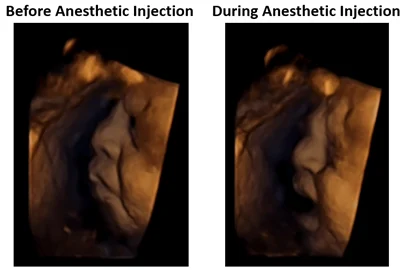
“The current standard of medical care calls for unborn babies to receive pain medication during fetal surgery starting at 15 weeks. In fact, modern 3D and 4D ultrasound enables us to see an unborn baby cry and grimace when receiving that injection of pain medication in utero. Their behavior is just like other kids when they get a shot at the pediatrician’s office.”




Add your voice to the fight for life — follow SBA and join the movement.