






A Person’s a Person, No Matter How Small: The 14th Amendment Case for Protecting Unborn Children Nationwide
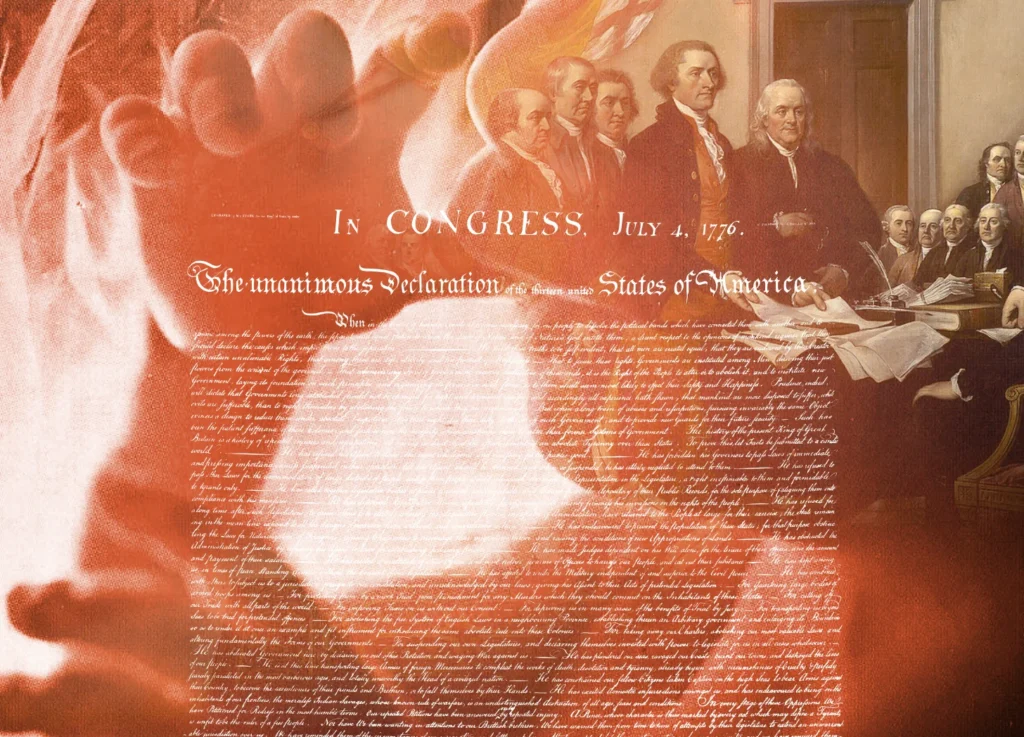
The Fourteenth Amendment to the U.S. Constitution
Section 1
All persons born or naturalized in the United States, and subject to the jurisdiction thereof, are citizens of the United States and of the State wherein they reside. No State shall make or enforce any law which shall abridge the privileges or immunities of citizens of the United States; nor shall any State deprive any person of life, liberty, or property, without due process of law; nor deny to any person within its jurisdiction the equal protection of the laws.
…
Section 5
The Congress shall have power to enforce, by appropriate legislation, the provisions of this article.
At 158 years old, the 14th Amendment still makes the news.
Ratified on July 9, 1868, five years after the Emancipation Proclamation, three years after the 13th Amendment formally abolished slavery in the law nationwide, its text appears straightforward and its intention a matter of public record—yet its exact meaning continues to be intensely debated. If who counts as a citizen has been contentious, the even more basic question of who counts as a person—at least under the constitutional definition—is no less.
The Amendment states that born people are a class of citizens, but the word “person” precedes that. So are human beings before birth persons? Pro-life advocates, of course, answer yes. They might respond in the phrasing of famed author Dr. Seuss: “A person’s a person, no matter how small.” And with good reason. A modern dictionary definition doesn’t rule the unborn out. Science provides supporting evidence: they belong to the human species, they are distinct individuals with their own DNA, etc. But that still doesn’t completely answer whether they are for the purposes of the 14th Amendment.
The view that they are has grown, thanks to some eminent champions.
In 2017, Josh Craddock, a scholar affiliated with James Wilson Institute for Natural Rights and the American Founding and later the Federalist Society, argued just that in an influential piece in the Harvard Journal of Law & Public Policy: unborn children “are legal ‘persons’ within the original meaning of the Fourteenth Amendment.” It became one of the most cited and downloaded constitutional law papers on the open-access database SSRN. Not every good-faith intellectual on the right agrees. Some pro-life advocates believe a Human Life Amendment to the Constitution is the only way or still the best way to protect the unborn (and the Republican Party platform called for such an amendment for decades). The late Supreme Court Associate Justice Antonin Scalia, too, famously argued that the Constitution’s alleged silence necessarily means federal lawmakers have no role. Craddock acknowledges this, but swiftly rejects the idea that the right to life can only be determined by zip code and majority rule.
John Finnis, Oxford’s Professor of Law and Legal Philosophy Emeritus, as well as Permanent Senior Distinguished Research Fellow at the de Nicola Center for Ethics and Culture at Notre Dame, quite literally wrote the book on the topic of natural law and rights. His essay “Abortion Is Unconstitutional” created a stir again in 2021, weeks before the U.S. Supreme Court accepted the Dobbs case that would ultimately reverse Roe v. Wade more than a year later.
In it, Finnis methodically takes the reader through Blackstone’s Commentaries, an English work that informed the Declaration of Independence and served as the foundation of American law for generations, showing that babies in utero were not excluded at all from the widely accepted, common-law understanding of “person.” He goes over the difference between natural persons (individual human beings) and legal persons (groups, entities, organizations), considering both the stated intentions of Amendment drafter John Bingham and the scope of the text itself. And he dismantles the faulty reasoning and history (also expertly addressed by National Review’s Ramesh Ponnuru) that gave the majority opinion of Roe v. Wade a superficial appearance of legitimacy.
Reviewing legislative history in the states, he concludes:
By the end of 1849, eighteen of the thirty states had antiabortion statutes; by the end of 1864, twenty-seven of the thirty-six; and by the end of 1868, thirty of the thirty-seven states—including twenty-five of the thirty ratifying states, along with six territories.
Craddock, in support of Finnis, notes, “By 1883, seven more states joined those thirty that prohibited abortion at all stages by statute, irrespective of quickening—Colorado, Delaware, Georgia, Minnesota, North Carolina, South Carolina, and Tennessee.”
Another longtime proponent of 14th Amendment protections for unborn children and heavy hitter in the conservative legal movement, Princeton’s McCormick Professor of Jurisprudence Robert George, joined Finnis on an amicus brief supporting the reversal of Roe v. Wade and Planned Parenthood v. Casey in the Dobbs case. Their brief further deconstructs the common objection that “quickening”—an older term for when the unborn baby’s movements can first be felt—is ultimately an important distinction when it comes to protection in the law.
Conservative attorney Josh Hammer, Craddock’s James Madison Institute colleague, also rejected the states-only position as essentially a discriminatory one and traced the philosophical roots of their stance back even further.
SBA’s View: Ambitious Consensus
We believe in using the democratic process to right wrongs. We know it works, because we’ve seen it over and over in American history.
Roe v. Wade did steal a tremendous human question from the people and elected lawmakers most directly accountable to them. In attempting to settle the issue of abortion by judicial fiat, replacing their judgment with its own, it left it more unsettled than ever for nearly 50 years. That’s why even jurists like Ruth Bader Ginsburg who were for legal abortion in principle criticized it or could not fully get behind it.
And yet, today, four years after Roe’s reversal, the shortcomings of the “states-only” strategy are more obvious than ever. It is no longer a theory. Some states allow virtually no abortions, while others have no limits for any reason or at any point up to birth. Since the Biden administration authorized mail-order mifepristone for the first time, federal agencies like the FDA, abortion activists, and heavily Democratic states form a triangle with all sides working to undermine enforcement of pro-life laws. In pro-life states alone, an estimated 15,000 unborn children a month are killed by illegal mail-order abortion drugs, leading to an increase in the national abortion rate rather than a decrease. The result is a situation very much like that in 1858, when Abraham Lincoln warned, “‘A house divided against itself cannot stand.’ I believe this government cannot endure, permanently half slave and half free.” It cannot be reconciled with the vision of the Founders in the Declaration of Independence, or with the guarantees of due process and equal protection under the Constitution.
The Dobbs decision stops short of making abortion illegal, handing power back to the people and their elected representatives to enact legislation. But it never says “states only” may do so. The 14th Amendment assigns Congress the job of enforcing those guarantees through “appropriate legislation.” Appropriate is not defined. That means it must be debated. The Amendment doesn’t require immediatism. What it does require is a Congress that will advocate the most ambitious protections that can pass both its chambers, without limiting good laws in pro-life states, with the consensus of a populace that already favors significant limits on abortion—and a champion in the White House who will sign those protections into law. SBA will be working tirelessly to support leaders who understand the moment and embrace the mandate they are so clearly given.
Add Your Name to Say You Stand for LIFE

When the U.S. Supreme Court overturned Roe v. Wade, our movement was given a historic opportunity. But the battle for life became much more difficult.
Add your name with thousands of others who are committed to protecting mothers the right to life for innocent unborn children.
Add My Name