








Abortion Drug Timeline: America’s 32-Year History of Abandoning Safeguards for Women and Approving the Deaths of Millions
Before Roe v. Wade, abortion activists began spinning abortion as “a decision between a woman and her doctor.” This framing took root when the decision was issued in January of 1973 and became the key tenet of the “pro-choice” movement for decades. Fast forward to 2025 and the abortion lobby has backed away from this talking point, opting instead to remove doctors completely with mail-order abortion drugs.
By 2023, abortion drugs accounted for 63% of abortions in the United States. There are two drugs used involved in what some refer to as a “chemical” or “medication” abortion. Mifepristone kills the baby by blocking progesterone and misoprostol induces labor. Over the span of two decades, abortion drugs have become so deregulated that anyone can obtain pills online from international or blue-state drug dealers without the involvement of medical professionals.
The United States’ abandonment of safeguards on the drugs has driven an increase in abortions nationally – 1.1 million abortions in a year – and an epidemic of women and girls who end up in the emergency room with serious complications.
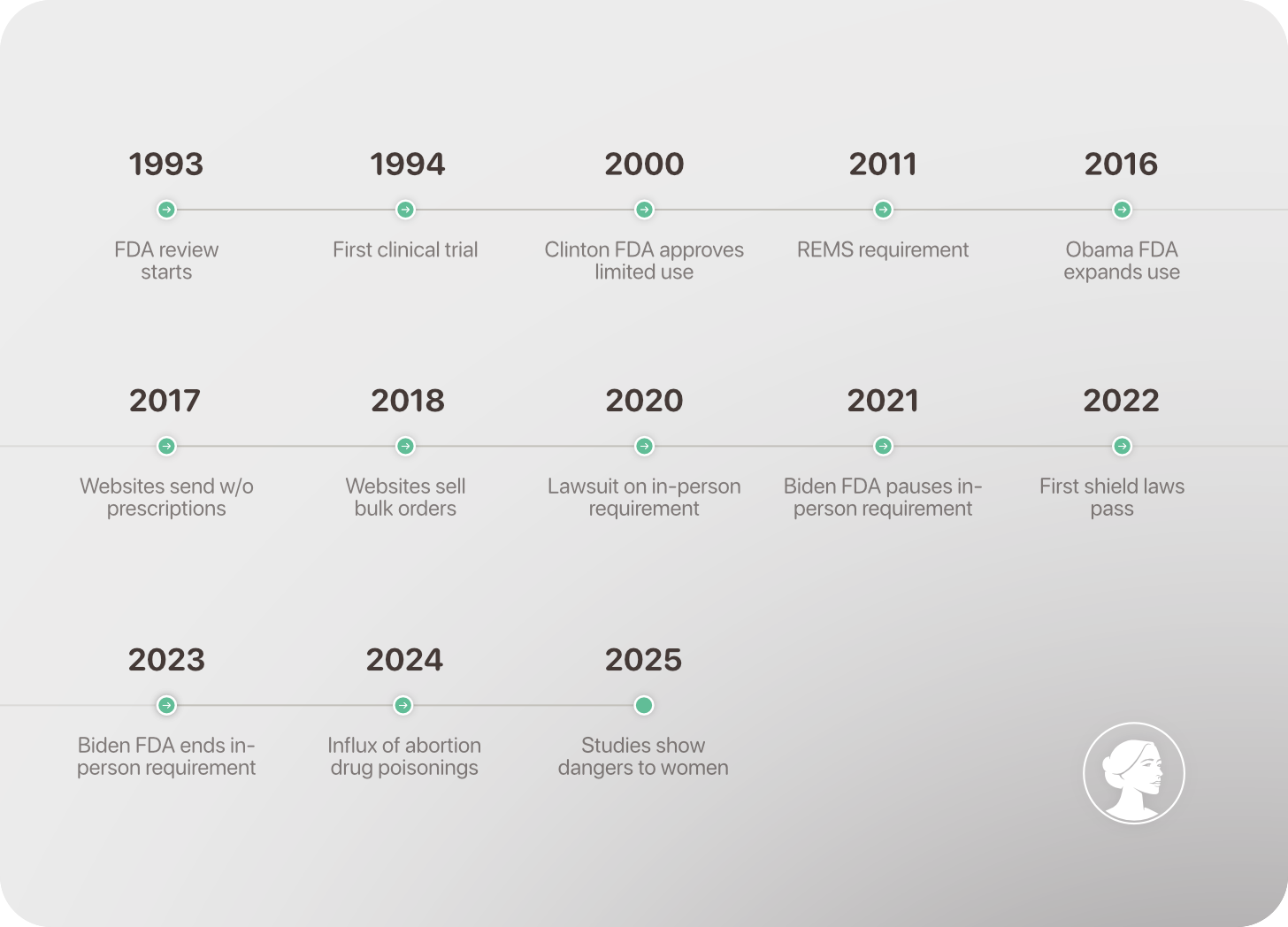
How did we get here? SBA’s regulatory timeline on abortion drugs reveals the history the abortion industry doesn’t want you to know.
1993:
Bill Clinton takes office and initiates an FDA review of mifepristone – also known as RU-486 – on the 20th anniversary of Roe v. Wade. Clinton aims to remove a ban on importing the drug so “Americans will be able to bring the drug into the country for their personal use consistent with existing FDA policies that govern drugs not approved for distribution.”
1994:
The Population Council, which shapes population control policies (and has a history of coerced IUDs in India and recommending forced sterilizations of men with three or more children), sponsors the United States’ clinical trial on mifepristone. The National Women’s Health Organization openly states the goal of “self-managed” abortions without doctors.
2000:
The Clinton FDA approves mifepristone for abortion up to seven weeks’ gestation. Only physicians with access to ultrasound machines can obtain the drugs. These doctors must have the ability to check for ectopic pregnancy and verify the stage of pregnancy. A two-week follow-up appointment is required after the woman takes misoprostol. Pro-life groups begin to warn about health risks to women.
2011:
The FDA creates the Risk Evaluation and Mitigation Strategy (REMS) program and applies it to mifepristone, applying the same regulations that were in place since approval. The REMS states mifepristone can only be administered in a hospital or clinic under the direct supervision of a certified medical professional.
2016:
The FDA extends mifepristone use for abortion to 10 weeks of pregnancy. The agency alters the REMS so non-doctors can administer the drug and stops collecting adverse events reports on any complications except for a woman’s death.
2017:
A 2017 study by pro-abortion researchers tests samples of “abortion pills” purchased online from outside the U.S. Their study finds none of the websites require a prescription to place the order; none of the mailed packages contain any patient instructions or information; several drug packages arrive with damage including pinprick holes in the foil of the blister pack; and testing reveals the contents of the pills are inconsistent from sample to sample, with one-quarter of samples containing under half the recommended dosage.
2018:
In 2018, an online review conducted by the Charlotte Lozier Institute finds at least 72 websites selling drug-induced abortion “kits” directly to consumers – some as generic online pharmacies and others as abortion-centered businesses. Some websites advertise bulk orders of four, five, and even up to nine drug-induced abortion kits bundled in one purchase.
2020:
In July 2020, the abortion industry takes advantage of the COVID-19 pandemic by obtaining a court order to block the FDA requirement that mifepristone be administered in person. The Trump administration fights back and the Supreme Court stays the court order, allowing safety protocols to remain until the Biden administration takes office.
2021:
By April 2021, the Biden FDA announces it will be suspending enforcement of the requirement of an in-person visit prior to obtaining mifepristone. Under this new rule, women are supposed to only use abortion drugs approved by the FDA in the U.S. But abortion drugs from outside the U.S. are also easily accessible, putting women at even greater risk.
2022:
Connecticut becomes the first state to pass a shield law in May of 2022. Shield laws allow out-of-state abortionists to prescribe and ship drugs to women, girls, abusive boyfriends and traffickers living in states where unborn lives are protected. These laws attempt to protect abortion drug dealers from legal repercussions when they kill children in the womb and send women and girls to the ER in other states.
2023:
The FDA formally removes the in-person requirement from the REMS. No in-person interaction with a medical professional is required for abortion drugs, putting women at increased risk for hemorrhaging, infection and sepsis.
2024:
The Biden administration’s allowance of mail-order abortion drugs gives rise to a new form of domestic violence: abortion drug poisoning. In February, Catherine Herring’s abusive husband is sentenced to serve only 180 days in jail for poisoning his wife seven times with abortion drugs. Catherine experienced serious complications that sent her to the ER and almost took her daughter’s life. Similar cases pop up in other states: Washington, Florida, Massachusetts, and Louisiana. Louisiana becomes the first state to criminalize abortion drug poisoning and add mifepristone and misoprostol to the controlled substance list. Meanwhile, Planned Parenthood of the St. Louis Region announces it will distribute abortion drugs via an app, “completely free of face-to-face interaction with a clinician.”
2025:
A growing body of evidence shows abortion drugs pose a much greater risk to women than advertised by the FDA and abortion industry. In April the Foundation for the Restoration of America and Ethics & Public Policy Center releases separate studies showing 1 in 10 women experience severe adverse events like hemorrhaging, infection and sepsis. A peer-reviewed article by the Charlotte Lozier Institute debunks the abortion lobby’s claim that the drugs are “safer than Tylenol.” CLI also conducts a study showing nearly 84% of abortion-drug-related ER visits were miscoded as natural miscarriages from 2016-2021; these miscoded visits are “significantly” more likely to be severe.
Twenty-three states now have shield laws that unconstitutionally refuse to recognize the laws and judicial processes of red states with pro-life protections. Republican attorneys general begin taking more action. Texas and Louisianainitiate lawsuits against an abortionist in New York whose prescriptions sent women to the hospital in each state. Missouri sues the national Planned Parenthood organization for lying about the dangers of the drugs. Arkansas and Texas send cease and desist letters to abortion pill mills. GOP attorneys general band together to send letters to Congress and the FDA spotlighting the dangers of shield laws and the need for the federal government to end blue states’ assault on the sovereignty of red states.
Start a Fundraiser

We fight for the voiceless everyday and we want you to stand with us. Become a Champion of LIFE by being an official fundraiser for SBA.
Fundraise